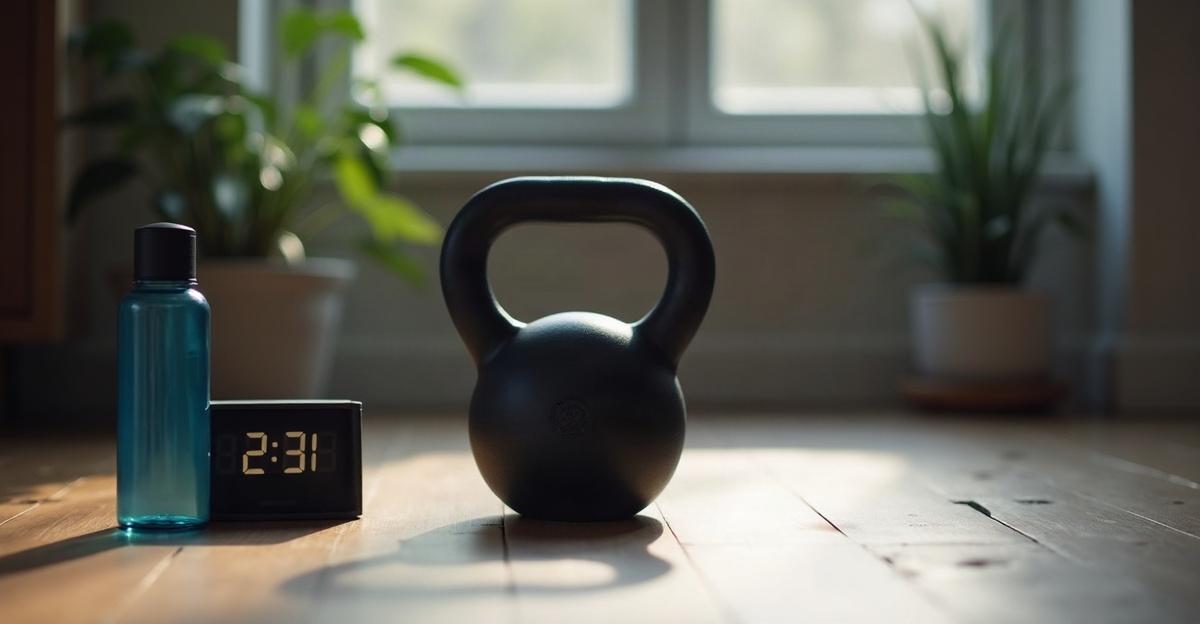
A full-body kettlebell workout uses one lift from each key pattern, cycled steadily for 15–25 minutes with tidy form. Choose a bell you can control for the session’s slowest lift, and organise rests between sides. Start light, move well, and end with something you could repeat.
What’s a solid full-body kettlebell template I can use every time?
A solid full‑body kettlebell template you can use every time covers five patterns in one circuit: hip hinge, squat, push, pull and carry SmartWOD.
Pick one move for each and run them in this order: hinge, squat, push, pull, carry. Example choices that work well: hinge = kettlebell swing; squat = goblet squat; push = single‑arm press; pull = single‑arm row; carry = suitcase carry. For the single‑arm lifts, work the left and right sides evenly.
On the swing, hinge at the hips and drive the bell with the hips, not the arms or knees; do not turn it into a squat pattern Wikipedia. Keep the shins quiet, back neutral, and let the bell float from hip power.
Move steadily from one pattern to the next and loop. Rest just enough to keep form crisp. If technique slips, stop the set and reset rather than forcing reps.
To add structure without overthinking, run the circuit as EMOM or AMRAP. EMOM suits fixed starts and tidy pacing; AMRAP lets you flow continuously for a set time. See the overview of both and when to use each in EMOM and interval protocols. Cadence runs either format: paste the circuit in and it builds the timer, with the next move readable mid-set.
Swap exercises within the same pattern when needed. For example, replace swings with deadlifts if technique or space limits, or rows with a band pull if grip is smoked from swings. Keep the five patterns, keep the order, and keep the reps crisp.
How heavy should my kettlebell be for this?
Pick the lightest bell that lets every rep stay crisp; as a beginner guide, women often start around 6–12 kg and men 12–16 kg Bells of Steel.
Match the load to the session goal. For strength-focused work, use a heavier bell for low reps and longer rests. Think sets you could push for one or two more tidy reps, then stop. Rest long enough to keep form the same on the next set. For conditioning, drop a rung, keep the reps or minutes tidy, and use short, planned rests so quality holds up across the block.
If your bells are 16, 24 and 32 kg, that’s the traditional 1, 1.5 and 2 pood sizing; one pood is about 16.38 kg Wikipedia. Those rungs make decisions simple: step up a rung for strength days, and step down a rung for conditioning. For example, if 16 kg swings feel powerful for sets without form drift, use 24 kg for crisp sets on a strength day. If 24 kg presses grind or tilt your torso, drop to 16 kg and keep the reps smooth.
Different lifts often need different bells. Most people hinge and swing heavier than they can press or squat. Choose the weight per exercise if you can. If you only have one bell, bias the load for the hardest lift you plan to do, and trim reps or add rest on the others to keep the standard.
Can you show a complete 15‑minute full‑body kettlebell session?
Yes: here is a 15‑minute full‑body kettlebell session you can run as written.
Illustration — 15:00 AMRAP
- Set a 15:00 AMRAP timer. Any countdown works; in Cadence, paste the session below and it sets up the AMRAP for you.
- Do 15 swings (hinge), 10 goblet squats (squat), then 5 single‑arm presses per side (push). Repeat this cycle for the whole 15 minutes, aiming for crisp, repeatable reps SmartWOD.
- Between rounds, add a pull and a carry of your own choosing — for example, one set per side of single‑arm rows, then a short suitcase carry per side (to the far wall and back) — to bring all five movement patterns into the session: hinge, squat, push, pull and carry.
- Keep rests brief and purposeful. If form slips, pause, reset, and continue.
What this session covers
- Swings: hinge
- Goblet squats: squat
- Single‑arm presses: push
- Single‑arm rows (between rounds): pull
- Suitcase carries (between rounds): carry
Run it as many quality rounds as you can in 15 minutes. Stop the set early if any rep gets loose. Quality first, then pace.
How many calories will this burn, and how often should I do it?
Expect around 20 kcal per minute during continuous, brisk kettlebell work, with about 13.6 kcal from aerobic and 6.6 kcal from anaerobic pathways Lake Norman Kettlebell (reporting ACE/UW-La Crosse study). Rough maths from that: 10 minutes ≈ 200 kcal, 15 minutes ≈ 300 kcal, 20 minutes ≈ 400 kcal. Your actual burn shifts with bell weight, pace, rest, and body size. If half of a 15‑minute session is rest (for example, 30s work / 30s rest), a closer estimate is about half the continuous figure: roughly 150 kcal for that block.
For frequency, 2–3 kettlebell sessions per week with at least one rest day between is a sound target TrainCalc. That leaves room for walking, mobility, or light cardio on the other days. If recovery is solid, a third kettlebell day can work; if you feel beat‑up, keep the days but trim sets or reps instead of pushing through sloppy form.
There is evidence that supervised hardstyle training can be tolerated more often: in the BELL trial, insufficiently active adults aged 59–79 trained up to five days weekly for three months with only four non‑serious adverse events and very low dropout BMC Geriatrics. That does not make five days necessary. It shows the method can scale when coaching, load, and progression are managed carefully. At home, stay conservative and let how you recover guide the next week.
Do I need the Turkish get‑up in a full‑body workout?
You don’t need the Turkish get‑up for a full‑body kettlebell workout. It’s not required to hit the main patterns. But it is a useful whole‑body skill that ties together a roll, a lunge and a press, and teaches control under the bell.
If you use it, keep the volume low and the intent slow. Treat it as practice, not as conditioning. Place it when you’re fresh at the start, or save it for the end when the main work is done; avoid turning it into a high‑rep race Ladder (joinladder.com). Use a lighter bell than your main lifts. Move one step at a time. Pause at each position. Breathe. Switch sides after each rep. Stop if a step gets messy.
Simple placements that work:
- Primer: 1–2 singles per side, rest between, then go to swings, squats and presses.
- Finisher: 3–5 quality singles total, alternating sides, focusing on smooth transitions.
If time is tight, skip it. You’ll still have a complete session from the hinge, squat, push and pull work in your plan.
Origins-wise, the get‑up is often linked to Turkish wrestling over two centuries ago, where trainees progressed through stages with the movement Mirafit. That history adds colour, but doesn’t change how to train it today: slow, clean, and never rushed.
Can I do a full-body kettlebell workout at home with one bell?
Mostly, yes, with a few adjustments.
- Pick one move for each pattern: swing (hinge), goblet squat (squat), single‑arm press (push), single‑arm row (pull), suitcase carry (carry). These five cover a full‑body session SmartWOD.
- Set a 15‑minute AMRAP and rotate through those five in that order. Alternate arms each round for presses, rows and carries. A sample 15‑minute flow of swings, squats and presses per side is a common AMRAP structure you can mirror when you add rows and carries SmartWOD.
- Choose a starting bell you can control well (see the weight guide above). If presses or rows feel sloppy, go lighter; if the bell flies on swings and squats, go heavier. For a strength‑leaning vs conditioning‑leaning day, keep the load choice simple and see how to structure a kettlebell session.
- For swings, use the hip-drive cue described above, and keep the bell close with shins vertical.
Lodestone
The Lodestone kettlebell workout generator builds a session after you choose strength or conditioning. It’s in development with a waitlist.
Finished Lodestone sessions will go straight into Cadence, the interval timer for EMOM, AMRAP and Tabata work, which is available now. Until Lodestone launches, you can paste the template or the 15-minute session from this page into Cadence and train with it today.
Frequently asked questions
What’s a good full body kettlebell routine for beginners?
Start with a simple circuit for 3–4 rounds: 10–15 two‑handed swings and 8–10 goblet squats, resting as needed between rounds Kettlebells Workouts. Add single‑arm rows and presses as you learn the movements.
How many days a week should I do kettlebell workouts?
Aim for a few sessions per week with at least one rest day between. Adjust the bell and volume so you recover well.
How many calories does a 30‑minute kettlebell workout burn?
It varies a lot; bell weight, pace and body size all change it. See the calorie section in this piece for study‑based estimates and use them as a rough guide, not a target.
Do I need to learn the Turkish get‑up?
No, you can run a full‑body session without it. It’s a valuable skill; if you use it, keep reps low and place it at the start or end, not as high‑rep conditioning.
Can I train full body with just one kettlebell?
Mostly. Choose one move per major pattern and include a carry, and alternate arms each round on one‑sided moves.
Sources
- SmartWOD (2025-07)
- Wikipedia
- Wikipedia
- Lake Norman Kettlebell (reporting ACE/UW-La Crosse study)
- TrainCalc (2025-05)
- BMC Geriatrics (2022)
- Ladder (joinladder.com)
- Mirafit (2025-09)
- Kettlebells Workouts (2025-08)
Sources checked November 2026.